
A humble exploration of their wisdom, symbolism, and presence in our lives.
At the lotus feet of Maa Tara and Batuk Bhairava Baba.
How does one begin to understand the Divine Mother, whose presence is infinite, with a mind that is finite?
Perhaps we begin with devotion—and the willingness to remain a student.
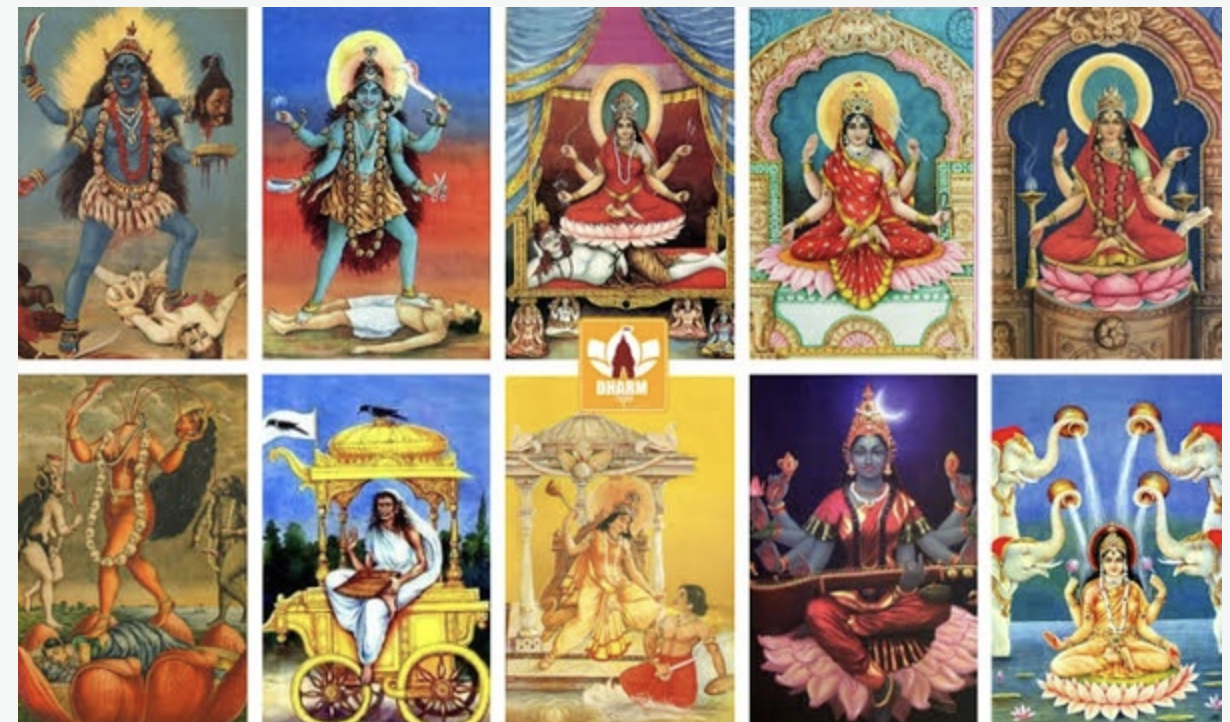
In the Shakta tradition, the Dasha Mahavidyas hold a profound place. These ten great wisdom goddesses reveal different expressions of Adi Parashakti, the Supreme Divine Mother.
With this post, I begin a journey of learning and sharing. Over time, I hope to explore each Mahavidya: her iconography, significance, and the wisdom she offers a spiritual seeker.
I write with limited understanding and deep reverence. May the Mother’s grace help me see more clearly, understand more deeply, and express what I learn with humility.
One Mother, Ten Expressions
Dasha means ten, and Mahavidya is often translated as great wisdom or great knowledge.
There are different accounts of how the Mahavidyas manifested. Exploring those narratives is a subject in itself. Here, I want to begin with the understanding that lies at the heart of my devotion: all ten are manifestations of the one Divine Mother.
Their forms differ. Their symbolism differs. The ways a sadhaka—a spiritual practitioner—approaches and experiences them may differ. Yet, in my understanding, their essence is one.
The Mother who nourishes can also dissolve our attachments. The Mother who protects can confront us with truths we would rather avoid. Her compassion may arrive as reassurance, discipline, or a change we do not yet understand.
Approaching the Mother
I approach Mahavidya sadhana with reverence. Their fierce imagery conveys a power that asks for humility, preparation, and respect.
In the approach I have learned, worship begins with Ganesha and Bhairava, seeking their blessings before proceeding further. Specific practices and sequences belong to the teachings of one’s guru and lineage.
For me, there is also a subtle distinction between choosing a deity and feeling called toward her.
I believe that, at a certain point, the seeker experiences the relationship as the Mother’s invitation. What begins as curiosity deepens into devotion, and devotion gradually becomes surrender.
The Ten Mahavidyas
These brief descriptions offer a starting point. No single quality can contain the fullness of any Mahavidya.
1. Maa Kali — Time and Liberation. Maa Kali confronts us with impermanence, the dissolution of ego, and the reality beyond the identities we cling to. In her, I contemplate both time and that which transcends it.
2. Maa Tara — Guidance and Deliverance. Maa Tara is the Mother who guides the seeker across the ocean of worldly existence. To me, she embodies protection, wisdom, and the grace that carries us through uncertainty.
3. Maa Tripura Sundari, or Shodashi — Beauty and Wholeness. She reveals divine beauty, harmony, and bliss. Her beauty invites us to recognize the sacred presence within existence itself.
4. Maa Bhuvaneshvari — The Vastness That Holds Creation. As the sovereign of the worlds, she evokes the boundless space in which life unfolds. I contemplate her as the Mother whose presence holds all creation.
5. Maa Tripura Bhairavi — The Fire of Spiritual Discipline. She embodies the intensity of sincere practice. Her presence reminds me that transformation requires steadiness, responsibility, and the courage to face what binds us.
6. Maa Chhinnamasta — Surrender and Self-Transcendence. Her striking, self-decapitated form invites contemplation of life, sacrifice, and the surrender of ego. For me, she raises a difficult question: what am I willing to release in order to see more clearly?
7. Maa Dhumavati — Wisdom Through Loss and Detachment. Her smoky, widowed form brings us face to face with absence, disappointment, and impermanence. I see profound compassion in her: the Mother remains present even when life takes away what once made us feel secure.
8. Maa Bagalamukhi — The Power to Still. Associated with arresting harmful forces and silencing destructive speech, she also inspires me to reflect on restraint—the ability to pause before anger, fear, or reaction becomes action.
9. Maa Matangi — Speech, Music, and Expression. She is associated with knowledge, speech, music, and the arts. Her presence reminds me to consider how I use my voice, what I create, and whether my expression serves truth.
10. Maa Kamala, or Kamalatmika — Abundance and Grace. Her lotus imagery evokes prosperity, beauty, and flourishing. I understand her abundance to include material well-being as well as generosity, gratitude, and inner richness.
The Mahavidyas are also associated with forms of Shiva or Bhairava in different traditions. Familiar pairings include Maa Kali with Mahakala and Maa Tara with Akshobhya. However, these associations vary across texts and lineages. Maa Dhumavati, particularly, is commonly represented as a widow, making a single, uniform list of consorts difficult to present without qualification.
I hope to explore these relationships more carefully as I write about each Mother individually.
How I Contemplate Their Presence
The following is my own symbolic reflection—a way of bringing these vast ideas closer to my understanding.
When I imagine existence before name and form, I contemplate Maa Kali: dark, boundless, beyond the measures through which the mind understands the world.
When I imagine the first spark of emergence, I think of Maa Tara. This is a personal image through which I contemplate her presence.
As creation unfolds in beauty and harmony, I see a reflection of Maa Tripura Sundari.
In the vastness that accommodates and sustains it, I contemplate Maa Bhuvaneshvari.
Then my attention turns inward, toward the life of the sadhaka.
Spiritual practice asks us to face habits, attachments, and tendencies that keep us bound. It also asks us to fulfil our responsibilities in the world. In the discipline needed to hold both, I contemplate Maa Tripura Bhairavi.
Even on a spiritual path, ego can quietly take ownership: my practice, my knowledge, my progress. Maa Chhinnamasta reminds me to examine that possessiveness and learn surrender.
Life also brings loss, financial difficulty, disappointment, and conflict. I do not understand Maa Dhumavati simply as a promise that these experiences will disappear. I see her as the compassionate Mother who can reveal wisdom within them and loosen our dependence on what cannot last.
When faced with hostility or harmful speech, I turn my thoughts toward Maa Bagalamukhi. Alongside protection, I seek the restraint to avoid becoming a source of harm myself.
Through Maa Matangi, I reflect on the power of expression. Speech can clarify or confuse, heal or wound. May what I say—and what I choose to leave unsaid—come from greater awareness.
In Maa Kamala, I contemplate abundance. Wealth has its place in life, but so do contentment, discernment, generosity, and a heart capable of gratitude.
I do not see these as fixed stages that every seeker must follow. They are ways I reflect on the Mother’s presence across different experiences of life.
A Teaching That Brought These Ideas Closer
One of my gurus once explained the Mahavidyas through a simple analogy drawn from everyday life.
As I understood the teaching, learning to master compulsive desire frees energy for purposeful action. Purposeful action supports growth. Growth asks for humility, and humility makes room for detachment. Restraint helps us navigate conflict, while thoughtful speech and creative expression improve how we participate in the world. Discipline sustains that participation, and abundance can then be received with gratitude.
In that analogy, Maa Kali pointed toward freedom from compulsive desire; Maa Tara toward purposeful movement; and Maa Tripura Sundari toward growth and beauty.
Maa Chhinnamasta reminded us to release ego, and Maa Dhumavati to cultivate detachment. Maa Bagalamukhi represented restraint amid conflict, while Maa Matangi brought attention to speech and expression. Maa Bhairavi called for discipline and balance. Maa Kamala evoked abundance, and Maa Bhuvaneshvari a spacious sense of belonging within life.
I hold this as a teaching aid. The meaning of each Mahavidya extends far beyond any modern analogy, and their sacred imagery deserves deeper contemplation than a single explanation can offer.
What stayed with me was the invitation to bring spiritual understanding into daily conduct: how I work, respond, speak, fulfil my duties, and relate to what I have.
Grace and What We Cannot Comprehend
I believe the Divine Mother’s grace can loosen even our deepest bondages. Yet I cannot claim to know how or when that grace will unfold.
Nor do I see devotion as a guarantee of wealth, freedom from conflict, or a life without hardship. Karma, effort, circumstances, and grace remain subjects of profound mystery.
The wealth I seek includes clarity, courage, devotion, discernment, and inner freedom. I pray for the ability to receive what comes with gratitude and meet what is difficult with steadiness.
As I continue to learn, I will share more about each Mahavidya—her form, symbolism, significance, and the questions her presence awakens in me.
This is a beginning, offered with the understanding I have today.
May Maa Tara guide my understanding. May Batuk Bhairava Baba grant me courage and steadiness. May the Divine Mother help me recognize her presence in every form.
At her lotus feet.